
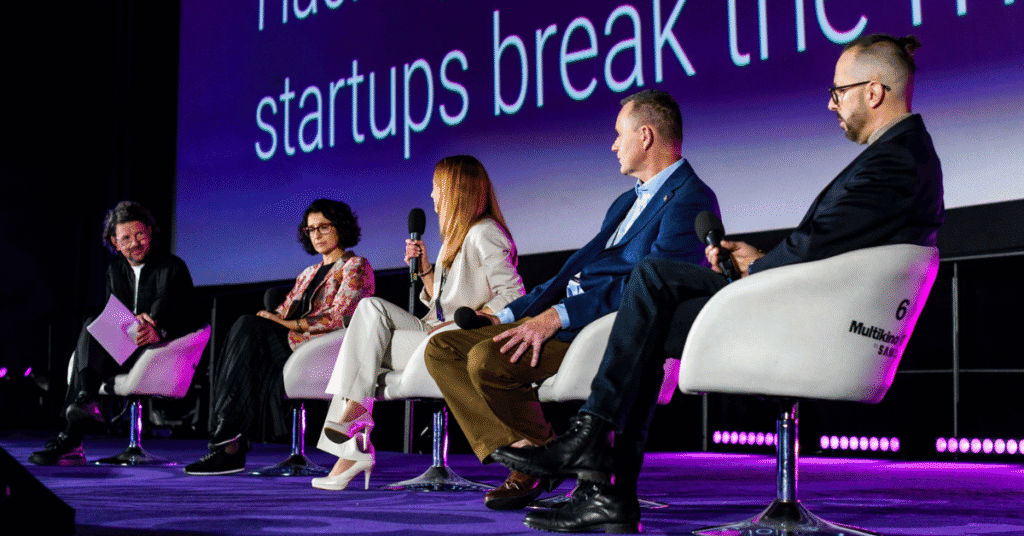
Can you successfully run a mission-driven startup in Poland? Or is “having a mission” just an excuse young companies use when they’re not profitable? These were some of the questions posed by Jarosław Sroka, Member of the Management Board at KI Next and InCredibles Coordinator, during the leaders fireside “Hacking Tradition: How Polish Startups Break the Mould.”
The conversation at Masters & Robots 2025 featured the finalists of the InCredibles mentoring programme:
- Agnieszka Czmyr-Kaczanowska, Founder & CEO of Talenti.pl,
- Michał Matuszewski, Founder of AILIS,
- Robert Kukułowicz, Founder of USE WASTE,
- Katarzyna Goch, Co-founder & CEO of iYoni.
Is Poland a place for impact innovation?
One of the key topics was whether Poland provides a favourable environment for startups.
“Is it even possible to be a young tech entrepreneur in Poland when every system – from corporations to public administration – sucks innovators in like quicksand, only to drown them in grants, bureaucracy and investors from hell?” – asked Sroka provocatively.
Despite the challenges, the panellists agreed that technological projects can indeed thrive in Poland. They stressed, however, the need for more flexibility from investors and longer investment horizons.
“Investors expect a quick return on investment, so they naturally favour sectors that offer an almost guaranteed profit,” said Katarzyna Goch.
“In Poland, investment funds usually look at a two- or three-year cycle. In our sector – medical technology – it takes five to seven years,” added Michał Matuszewski.
When asked what keeps them in the country, Matuszewski responded:
“For me, it’s a kind of economic patriotism. Without a healthy society, there’s no strong economy; without a strong economy, there’s no healthy state. We have so many brilliant young people working on technology, and we’re proving that it can be done in Poland.”
Robert Kukułowicz added that Poland is only the beginning, with international opportunities and partnerships emerging naturally as their businesses grow.
Mission and money – how to balance both?
A major theme of the discussion was how to combine purpose with profitability. Sroka pressed further: is “impact” just an alibi for when the business doesn’t add up?
“Having a mission is what keeps me in this role. If I only wanted to make money, there are much easier, more comfortable ways to do it,” said Katarzyna Goch.
Agnieszka Czmyr-Kaczanowska agreed:
“Solving complex social problems through business tools requires a deep understanding of their causes. It’s one of the hardest forms of entrepreneurship – combining mission with the need to earn money – but it brings immense satisfaction.”
The panellists concluded that success in an impact-driven startup isn’t measured solely by profit, but by real social impact and the ability to create solutions that change the world.
The session closed with a shared reflection: despite many challenges, Polish startups are becoming increasingly mature, bold and self-aware, ready to shape the future of an economy built on innovation and social responsibility.