
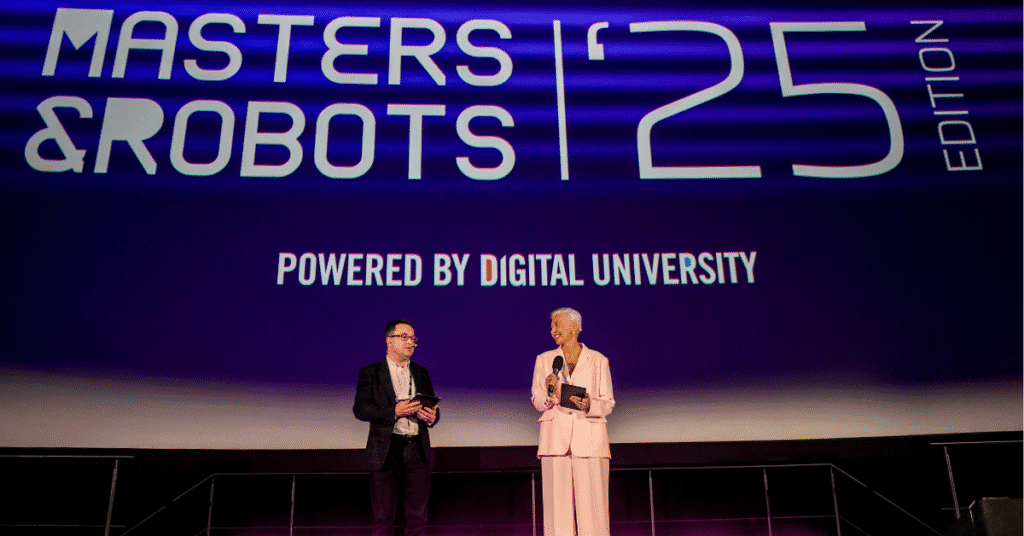
We live in a world driven by data, algorithms and artificial intelligence. Yet it is still us who control technology – and decide where and how we wish to use it. That is why the 9th edition of Masters & Robots focused on people and their role in digital transformation across work, business and education.
“Unlike previous ones, the current technological revolution blurs the lines between the physical, digital and biological worlds. It disrupts every sector globally, and its scale and complexity will bring changes humanity has never experienced in such a short time. We don’t know how it will unfold yet, but one thing is clear – our response must be integrated and global, spanning public and private sectors, academia and society. It is we, humans, who must shape and design it – so that technology serves us, not the other way around,” said Jowita Michalska, CEO of Digital University and founder of the Masters & Robots conference.
A similar message came from Krzysztof Gawkowski, Minister for Digital Affairs and Deputy Prime Minister, who stated:
“Digital transformation must include every citizen – everyone has the right to benefit equally from the opportunities it brings. This is how we have designed the Ministry’s digital strategy. It focuses on three areas: the state, the economy and people – and the collaboration between them.”
People behind the wheel of technology
The central role of humans in technological change was explored by experts gathered on 21–22 October at Multikino Złote Tarasy in Warsaw. Under the theme “Time to act!”, the 9th edition of Masters & Robots encouraged participants to take concrete steps towards actively shaping the future.
On the first day, Professor Marek Kowalkiewicz – a global authority in digital economy and AI from Queensland University of Technology – explained why and how we should delegate more of our work to algorithms.
Supreet Singh Manchanda, investor and CEO of Raiven Capital, emphasised that AI depends on humans far more than we might think. Panel discussions focused on how to conduct digital transformation with people in mind, and how technology can foster equality and develop future skills.
The day closed with inspiring talks on ethics and bias in the workplace. Dr. Poornima Luthra, a leading global expert on diversity, highlighted the key stereotypes shaping today’s labour market and stressed that real change begins with awareness and responsibility.










Human emotions and wellbeing in a digital world
Day two of Masters & Robots 2025 centred on human emotions and wellbeing in an increasingly automated world.
Dr. Michelle King underlined that the future of work depends on self-awareness and collaboration skills:
“Collaboration is key,” she said, citing studies showing that as many as 82% of people now work with others.
Equally moving was the talk by Dr. Frederik G. Pferdt, former Chief Innovation Evangelist at Google, who invited participants to reflect on how they want to shape their own futures and take ownership of that process.
“The future isn’t about technology – it’s about the feeling we all want to experience,” he later said in conversation with Przemek Gdański, CEO of BNP Paribas Bank Polska.
Leadership and entrepreneurship were also high on the agenda. Jarosław Sroka, coordinator of Sebastian Kulczyk’s InCredibles programme, moderated a discussion with founders of mission-driven companies. Together, they explored how to balance social impact with business performance – and whether Poland offers a supportive environment for such ventures.
The conclusion drawn from the two days of the conference was clear: true transformation requires not only advanced tools and solutions, but above all responsibility, empathy and reflection. Real change begins within ourselves.
Innovation leaders supporting Masters & Robots
Strategic Partners: Ministry of Digital Affairs, BNP Paribas Bank Polska, InCredibles Programme by Sebastian Kulczyk, and Kulczyk Investments.
Main Track Partners: Interzero, IKEA, VeloBank, Hewlett Packard Enterprise, and Intel.
Track Partners: Polish Cashless Foundation, Central Information Technology Centre, Mastercard, InPost, BLIK, Synektik, Rockwell Automation, BCG Platinion, Edenred, Nationale-Nederlanden, Polish Agency for Enterprise Development, PZU, Development Services Database, Polish Development Fund.
Honorary Patrons: Minister of Education, Ministry of Culture and National Heritage, Ministry of Climate and Environment, and the Mayor of Warsaw.